Changes in 2026-2027
Effective August 1, 2026 (2026-2027 Season)
The Elk River Youth Softball Committee is implementing several structural changes beginning
with the 2026-2027 season. These changes are designed to improve coaching consistency,
strengthen player development, increase collaboration across teams, and establish a foundation
for future program growth.
The recommendations focus on:
- Selecting coaches before team formation and requesting a year-long coaching
- commitment.
- Moving official tryouts to the fall and using a coach-collaborative team
- formation model.
- Creating a more unified age-group approach to player development.
- Establishing fall team placement as the primary placement process for the year.
- Transitioning winter development programming to coach-led instruction.
- Supporting optional winter tournament opportunities for interested coaches and players.
- Empowering coaches to have more autonomy in team structure, class and placement
- when partnering with coaching peers in their age groups.
The overarching goal is to create a more consistent developmental experience for athletes while
preserving the association-first model that serves all players.
1. Coach Selection Process
Old Process:
Head coaches were selected through a formal interview process late winter/early spring in order
to have coaches selected in advance of spring tryouts. Fall coach selections were reactionary
and based upon availability and additional feedback from Spring/Summer season.
Coaches applying for a position were expected to commit to their team assignments/seasons
only and coach assignments were tied to their own respective player’s (child/grandkid/etc)
evaluation score.
New Process:
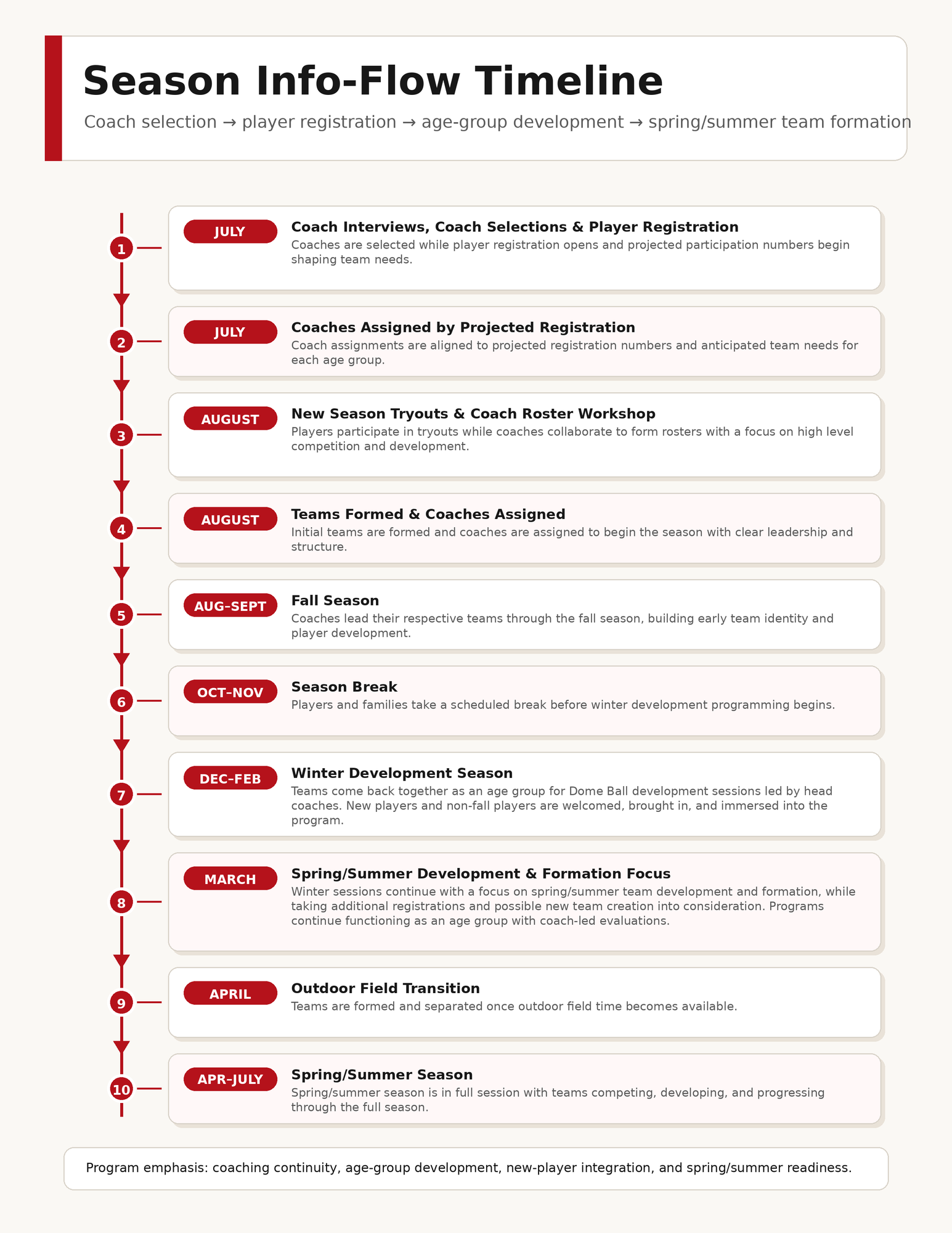
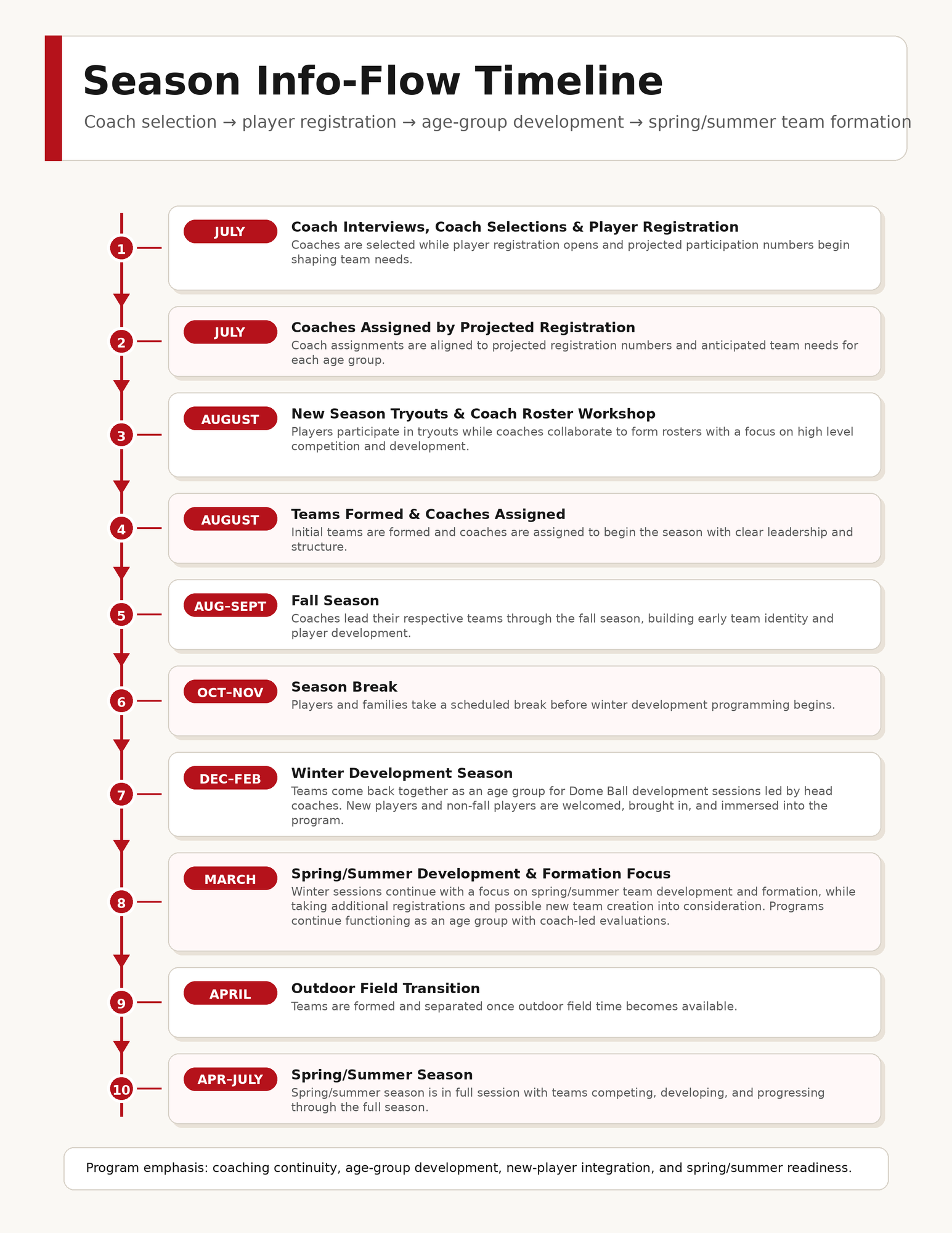
Head coaches will be selected through a formal interview process each July in order to have
coaches selected in advance of tryouts (Aug 6th).
Coaches applying for a position are being asked to commit to:
- Fall season
- Winter development season (Formally known as Golden Gloves/Heavy Hitters)
- Spring/Summer season
Coaches will be expected to:
- Approach their age group as a single program rather than separate teams.
- Collaborate with fellow coaches within the age division.
- Foster a positive culture focused on player development and teamwork.
- The revised team formation process will place greater emphasis on selecting the strongest coaches available regardless of where their child may ultimately be placed.
Why This Change?
The previous structure created inconsistencies in coaching philosophies, player development,
and communication across teams within the same age group.
Selecting coaches before team formation, removing the direct tie to child placement and team
leadership and recommended a year-long commitment will:
- Improve consistency in instruction.
- Create stronger relationships between coaches and players.
- Promote collaboration across teams.
- Allow age groups to operate as one developmental program.
- Better support long-term player growth.
This model also empowers coaches to lead player development while ensuring board support
and organizational alignment.
2. Fall Tryout Model & Team Formation
Old Process:
Official team placement tryouts were conducted in both Fall and then again in Spring/Summer.
Teams were evaluated by 3rd party evaluators and scored for team placement with a select
limited # of bubble players eligible to be picked during coach selections. The top 7 scorers
were locked into the top team and any non- bubble players were automatically locked onto the
bottom team. A select number of bubble players were eligible for coach pick. Players not able
to try out were automatically locked into the bottom team.
Tryouts were:
- Conducted outdoor in the fall and indoors for spring/summer
- multiple day formats.
- Administered by Optimize (or other 3rd party evaluators).
Team Selections were:
- Predominantly driven by Optimize scores
- Directly locked in players to various teams based on a one day player snapshot
- Players not able to attend tryouts were automatically locked into the bottom team
- Had minimal coach involvement in team formation and roster development
- Became an unintended byproduct to trigger coach selections as coaches were tied
- directly to the evaluation score of their daughter (if a parent/coach) making coach
- interviews seemingly redundant.
New Process:
Official tryouts will move to the fall following the spring/summer season.
Tryouts will:
- Be conducted outdoors
- Be completed in a single-day clinic format.
- Be administered by Optimize.
- Include coaches as observers and participants.
- Allow players to be evaluated while in their best form
Team Selection Process:
Age Groups with Three or More Teams
- Optimize scores will be used to identify and place the bottom seven players on a
- developmental team.
- Developmental teams will be placed at the C class level.
- Remaining players will be placed and selected collaboratively by coaching staff.
- Primary teams will be classified as B-level teams however coaches may choose to compete at the A level if appropriate
Age Groups with Two Teams
- Optimize scores will be used as a data point for coaches, not the determining factor in
- rosters
- Coaches will collaborate to create balanced teams and build out competitive rosters in
- order to focus on rapid development and competitive teams at B or above levels.
- Players will be placed and selected collaboratively by the coaching staff.
- Two primary teams will be classified (atleast) as B-level teams in an effort to eliminate C
- level competition which has shown to stifle development.
- Coaches also have the opportunity to collaborate and create an A team if the player
- levels are appropriate to do so and coaches align.
Why This Change?
- Reduce repeated tryout stress for players and families.
- Reinforces coaches as program leaders and the board as a support system
- Reduced cost to the association and creates opportunity to repurpose those funds on player/coach development initiatives
- Allows coaches to build teams earlier.
- Increases coach involvement and autonomy in team formation.
- Encourages collaboration between coaches and creates an age group/program approach
- Creates balanced, competitive and development-focused teams.
- Increases coach discretion and autonomy in building and selecting rosters
- Eliminates ties of player scores to coach selections, reinforces our ability to focus more
- on bringing in great coaches to the program
- Ensures coach continuation in the program
- This model places emphasis on player growth, team chemistry, and long-term development rather than relying solely on rankings or scores.
4. Year-Round Team Placement Model
New Process:
- Fall tryouts will serve as the official placement process for the year.
- Additional spring evaluations would only occur if registration numbers require the
- creation of an additional team not originally forecasted
- If an additional team is needed, the spring Optimize clinic would be used to evaluate
- players for placement.
- New or returning players who register after fall evaluations will continue to be welcomed
- into the program and placed on existing teams by the program coaches ensuring
- balanced, competitive and collaborative rosters at the conclusion of the winter indoor
- practice/development sessions
- Every registered player will have a roster spot.
Why This Change?
This approach provides:
- Greater stability for families.
- Consistent coaching relationships.
- More time focused on development.
- Reduced administrative complexity.
The goal is to spend more time developing players and less time conducting multiple placement
processes throughout the year.
5. Winter Development Program
Old Process:
Heavy Hitters & Golden Gloves
Outside coaches were brought in to lead age specific Saturday clinic programs
New Process:
Winter development sessions will be led by the coaches assigned to each age group.
Examples:
- 8U coaches lead 8U winter sessions (historically 8U time slot at HH/GGs)
- 10U coaches lead 10U winter sessions (historically 10U time slot at HH/GGs)
- 12U coaches lead 12U winter sessions (historically 12u time slot at HH/GGs)
- 6U programming continues to be supported by the board.
Why This Change?
Benefits include:
- Consistent instruction across fall, winter, and spring seasons.
- Stronger player-coach relationships.
- Greater accountability for development.
- Better alignment of coaching philosophies and expectations.
- Enables coaches to welcome new program players and immediately immerse
- them into the program
- Enables coaches to consistently monitor players for Spring/Summer placement that are:
- Developing thru the season
- New additions to the program
- Returning players who are multi sport athletes
Additionally, reducing outside coaching expenses allows the association to reinvest resources
into specialized player development opportunities.
Potential reinvestment areas include:
- Pitching instruction.
- Catching instruction.
- Position-specific development.
6. Winter Tournament Opportunities
Old Process:
Non existent within ERYSA
New Process:
Head coaches may choose to organize and participate in winter tournaments or games outside
of official association programming.
The board would:
- Support fundraising efforts.
- Support logistics where feasible.
Tournament rosters would be selected solely by coaches from their eligible player pool.
Participation would be voluntary and separate from official association activities.
Why This Change?
This creates additional opportunities for athletes seeking more softball without requiring (or expecting)
association-wide participation.
Benefits include:
- Additional development opportunities.
- Increased flexibility for families.
- Coach-led opportunities for competitive play.
- Continued support of multi-sport participation by keeping activities optional.
This mirrors existing practices where teams independently participate in additional tournaments
outside standard association programming.
Expected Outcomes for the 2026-2027 Season & Beyond
The committee believes these changes will:
- Improve coaching quality and consistency.
- Strengthen player development pathways.
- Increase collaboration across teams and age groups.
- Provide continuity between fall, winter, and spring programming.
- Enhance opportunities for pitchers and catchers.
- Reduce repeated evaluation cycles.
- Create a stronger organizational culture.
- Better position the association for future Mini Elks programming if desired.
The ultimate goal is to provide a more consistent, collaborative, and development-focused
experience that benefits all athletes while maintaining the values and accessibility of the Elk
River Youth Softball Association.
Please feel free to download and review the following associated documents:
2026-2027 FAQ
Then & Now Program Guide
Visual Infographic (Full year view)